|
|
Band Info
Artist
Stitch
Country Sweden
( )
Genre
Heavy Metal (early) / AOR / Melodic Rock (later)
Active ca 1980 - ca 1988
Media
Photos
Links Official Website
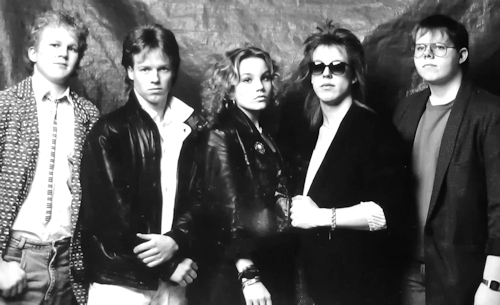
Members
Sussie Ax - Vocals (Revanch)
Conel Winblad - Guitar (Nasty, Göran Nordh (guest))
Ken "Getsz" Sundberg - Bass (Raceway, Wasa Express, Ion Olteanu Band, Yngwie Malmsteen's Powerhouse, Stuff, Funky Death Cap)
Jörgen "Joy Mallet/Jugge" Sverin - Drums (ESP, Remedy (guest))
Lars "Lasse" Nyström - Keyboard (Cat, Nannini/Nyström)
Former / Past Members
Robert "Bob" May - Vocals (Badland) Johan Längquist - Vocals ( Jonah Quizz, Notorious, Candlemass, Impulsia, D-Project, Johan Langquist The Castle, Sorcerer (guest), Blue Matter (guest), Colorblind (guest), Dead Kosmonaut (guest), The Project Hate MCMXCIX (guest), Thore Skogman (guest)) Göran "Glory North" Nordh - Vocals † ( Glory Bell's Band, Glory North, Göran Nordh, Nasty, Earth Gravity, Madness Age, X-Ray Free) Leif "Leffe/Leff Geno" Lindström - Guitar Jimmy "Neckles" Holmgren (Holmström?) - Guitar (Badland, Hal Halka) Anders "Wibbe" Wiberg - Drums ( Raceway, Cartago, Bye Bye, Fog, Through Time Tomorrow (guest)) Micke Olausson - Drums Håkan "Ian" Haugland - Drums ( Axia, Trilogy, Red Baron, Europe, Candlemass, John Norum, Yngwie Malmsteen's Rising Force, Toxic, Niva, Sha-Boom, Baltimoore, Ten 67, Clockwise, Last Autumn's Dream, Glenn Hughes, Brazen Abbot, Nikolo Kotzev, R.A.W (guest), Coldspell (guest))
Info from Janne Stark's Encyclopedia
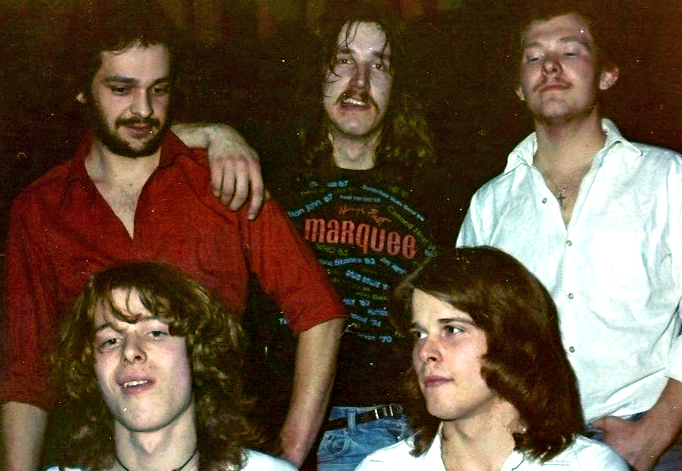
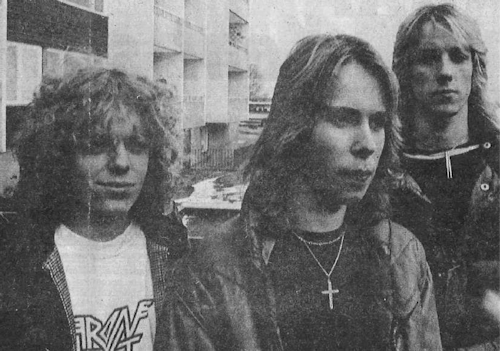
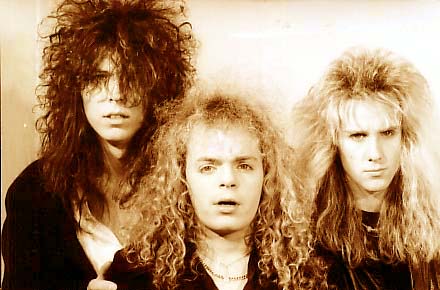
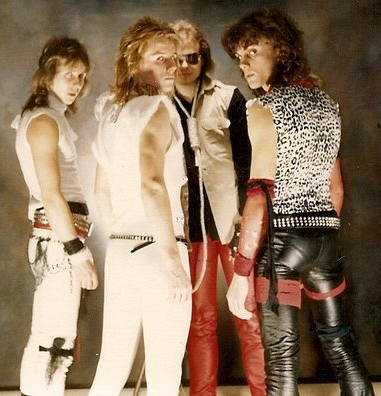
The first single is average 80s-style NWOBHM with quite monotonous vocals. Musically they were in the vein of Buffalo, Oxym etc. The line-up was then, besides Ken and Jörgen, singer Bob May, guitarists Leffe Lindström and Jimmy Holmström. Bob later joined the southern influenced band Badland. On the second single guitarist Winblad and keyboardist Lasse Nyström had replaced both guitarists, and singer Sussi Ax (ex-Revanch) had taken over the vocals. Style-wise they had now transformed into a mainstream commercial AOR band aiming for the big break. However, they disappeared. Håkan "Ian" Haugland, of Europe-fame was actually in this band for a short period. Bob May later teamed up wtih former Parasite/Rebelene guitarist Anders Holmström in a band mostly doing covers.
Stitch - The Story (from 2021 compilation booklet)Stitch was a Swedish heavy metal band foremost known for their first and by far heaviest single "Devils Deal". A powerful classic heavy metal number parred with the equally heavy flip side "Touch The Stars". A single that left a lot of fans want- ing more of the same. When the band finally returned, they had however not only switched singer, but also changed style. So, what happened, why and how? The story of Stitch goes way back. Ken "Getsz" Sundberg remembers he and guitarist Jimmy "Neckless" Holmgren met in school already back in 1968, at the pure age of 8. Ken continues: "A few years later, Jimmy and his cousin Janne Holmgren (who later started the legendary music store Tälje Musik, where me and Jimmy worked on and off) formed the band Hal Halka (Slippery Slip). Drummer Jörgen "Joy Mallets" Sverin, who was a few years younger but went to the same school, Storvretsskolan, teamed up with the cousins in the mid-70s. Jörgen and Jimmy then started borrowing the school hall on Tuesday evenings to rehearse together with guitarist Benke Johnsson, whom Jimmy knew from Sollentuna. Benke knew singer Bob May (originally from Cherry Point, North Carolina, USA), who now joined, together with bassist Anders "Pip" Larsson. I used to go down there on Tuesdays and impressed I would listen when they rehearsed. Back then I played tuba in the school brass band, which was far from cool", he says. At the age of 17 (in 1977) Ken finally got his first bass, an Arbiter, which he bought from Tomas Danko at the classic store Förstärkardoktorn (The Amp Doctor) in Stockholm. "I sat at home and learned to play to the Hurriganes record '16 Golden Greats'. So, Jimmy asked if I wanted to start a band with him and his friend Stefan Lund on drums. So, we started playing in Stefan's house, driving the neighbours crazy". A year later, Ken exchanged his Arbiter bass for a Rickenbacker copy and in the store he saw an ad which read: "Richie Blackmore inspired guitarist and Cozy Powell influenced drummer looking for bassist". Ken: "I was a big Deep Purple fan and called the number in the ad. The guy I met up with was a 16-year-old Yngwie Malmsteen. So, I joined his band Powerhouse, and played with them for a while". The "Cozy influenced drummer" in the ad was Micke Green, who later joined Red Baron, a band Stitch would later share stage with on many occasions, including what was considered the first real heavy metal gala at Kåren in Stockholm on November 22, 1981. The line-up featured Heavy Load, Stitch, Red Baron, Attack (featuring former Solid Ground guitarist Björn Uhr and drummer Åke Eriksson later in Bedlam, Wasa Express etc.) and lan Haugland's old band Trilogy. The show was arranged by Anders Tengner, Johan Holm (who made the Heavy Load artwork) and Bengt Grönqvist. The two latter would later start the magazine Hammer, which later evolved into Rocket. OK, now we jumped ahead a bit. Let's go back to 1978. Jimmy, Bob and Jörgen needed a bass player for their band, because their bass player Anders would be away for three months to work as a tour guide, and they needed a substitute. They asked Ken, who jumped on it. When Anders returned, they however didn't want to lose Ken, so Anders was fired. The band now went under the name Stuff. Stuff however didn't last long, possibly because they were kicked out of their rehearsal place. The following year, Jimmy got a place to rehearse in a shelter in the Tallid School in the Stockholm suburb of Fittja, in a rough neighborhood. He asked Ken if he wanted to join. At the time Ken was playing in Yngwie Malmsteen's band Powerhouse, so he quit to join Jimmy. They wanted to have Jörgen "Joy Mallets" Sverin back on drums, and fortunately his current band broke up and he joined. He also brought his guitarist Leif "Geno" Lindström. All they needed now was a singer, so they called their old front man, Bob, and he was all in. Stitch was now a fact! The new band started rehearsing covers, but they also wrote their own material right from the start. They recorded their first demo tape on January 4, 1980. It all went pretty well, and the band played loads of gigs on biker parties, youth centres and classic venues like Studion, Domino, Underground etc. In March 1982 the band won a band stand in Södertälje, and the first prize was to record a single. The studio was located underneath Roger Pincott's guitar shop SoundSide on Kocksgatan in Stockholm. The recording was however quite frustrating as the guy from the label called every 30 minutes to check how it was going, since it was going to be expensive if they weren't finished in time. The band was very dissatisfied with the final mix. The guy who was mixing the band, known as "Hep" Hasse, was also very unfamiliar with working with a hard rock band. Hasse, was really Hans "Hazze" Östlund, the notorious founder and original organ player of 60s pop band Hep Stars, later with Jerry Williams, so his experience in the heavy rock/metal genre was quite limited (putting it mildly). An interesting experience for the band, nonetheless. Another memorable moment was when Stitch were booked to play a show at Storänget in the small town of Nås in Dalarna, where the ad boasted "Swedish premiere for the American hard rockers (High energy-rock) - Come see their snake show - One of the big bands from the USA, directly from a Holland tour". The promoter had to tell the audience the snakes had become ill. Thankfully Bob is American, and the others had to fake it as best they could. When they got back home, they dropped out of the record deal (which also included the release of an album) since they didn't want to risk lynching. After this, drummer Jörgen left the band. He was soon replaced by Anders Wiberg (Cartago, Fog). Another incident after this was when the band played a show in the northern part of Värmland and their bus went off the road. The band came out ok. There were also plans of a 40-date tour in Sweden and supporting Motörhead, but it however didn't happen. With Anders on drums, they recorded another demo, this time using a Fostex 8-channel reel-to-reel, a nice upgrade from the previous simple cassette recordings. The band now started considering turning a bit more melodic and in a feature in Swedish hard rock magazine The Hammer they started talking about adding keyboards to the line-up. In 1983, Bob however left the band and they tried out some other vocalists, including Göran "Glory North" Nordh (Glory Bells/Band). In the end they opted for former Revansch singer Sussi Ax. Now, Jimmy also quit the band, and they tried out several other guitarists. One of the memorable ones was - Yngwie Malmsteen. Ken remembers: "We tried him out and he was totally shredding. He was a fantastic guitarist. When I drove him home, he asked if he got the gig and I had to tell him - No. He was like, WHY? So, I said he was basically too good for us. We would just be a short-term springboard until he found something better and more suitable, and he understood". They finally found guitarist Conel Winbland from the Huddinge based band Nasty. The drum spot was filled by lan Haugland (Trilogy/pre-Europe), who played some shows and did some simple rehearsal recordings with the band, but he was soon replaced by Micke Olausson. Sussi Ax played the role of Axet in the 1983 Swedish low budget horror movie " Blödaren" (The Bleeder), where the role as "Blödaren" himself was portrayed by Bedlam/Attack/Wasa Express drummer Åke "Bedlam" Eriksson. In 1984 Leif quit his guitar duties with the band but contin- ued as their sound engineer. On June 11, 1984, the four-piece, featuring Sussi, Ken, Micke and Conel went into Studio CTR to record five songs live in the studio. It was all done in one day. The band also did a lot of live shows. The style was now more melodic, and funk influenced. "Ever since I saw Mother's Finest on the Rockpalast show on TV I wanted a female singer and to go in that musical direction", Ken explains. This shows in some of their songs like "Funk (You)" and "Answer" from the aforementioned demo. Around 1985, the band was reinforced by keyboard player Lars Nyström. It was the 80s and the band wanted to try a new approach. Jörgen Sverin also returned on drums. The band did a lot of gigs, including a live show at Mosebacke, which was recorded by the radio for the show "Gästspel". Then after a while, Sussi decided to leave the band, and they teamed up with former Jonah Quizz/Candlemass singer Johan Längquist. They wrote some new songs and recorded them on their 4-track Tascam 244 porta studio. They had now turned into a more synth-oriented band, influenced by bands like Simple Minds (thanks to Johan). They never did any gigs with this line-up, and after a while Johan left and Sussi returned to the band. In 1986 Stitch again won a band stand which the rock magazine Okej arranged together with Sonet Records, at the Stockholm Hard Rock Café. This resulted in the band's second release, the more pop/rock oriented single "You Light My Fire/Can't Fight This feeling". The year after, the band entered the Rock SM Sweden band stand, but since they were un- der contract with Sonet, which they didn't like, they changed their name to Eye Level. The semifinal in Stockholm went well and the band won. However, in the final, the band that came second in the Stockholm semifinal beat them in the final and they ended up in second place. After this, the band fizzled out.
Bob later fronted southern rock band Badland, who released the demo "Kickin' Ass" in 1988 and also featured Jimmy, and Mud Pie South. Ken later played with the bands Led Boots and Wasa Express.
- Written by Janne Stark
Info from Janne Stark's Encyclopedia
The first single is average 80s-style NWOBHM with quite monotonous vocals. Musically they were in the vein of Buffalo, Oxym etc. The line-up was then, besides Ken and Jörgen, singer Bob May, guitarists Leffe Lindström and Jimmy Holmström. Bob later joined the southern influenced band Badland. On the second single guitarist Winblad and keyboardist Lasse Nyström had replaced both guitarists, and singer Sussi Ax (ex-Revanch) had taken over the vocals. Style-wise they had now transformed into a mainstream commercial AOR band aiming for the big break. However, they disappeared. Håkan "Ian" Haugland, of Europe-fame was actually in this band for a short period. Bob May later teamed up wtih former Parasite/Rebelene guitarist Anders Holmström in a band mostly doing covers.
Stitch - The Story (from 2021 compilation booklet)Stitch was a Swedish heavy metal band foremost known for their first and by far heaviest single "Devils Deal". A powerful classic heavy metal number parred with the equally heavy flip side "Touch The Stars". A single that left a lot of fans want- ing more of the same. When the band finally returned, they had however not only switched singer, but also changed style. So, what happened, why and how? The story of Stitch goes way back. Ken "Getsz" Sundberg remembers he and guitarist Jimmy "Neckless" Holmgren met in school already back in 1968, at the pure age of 8. Ken continues: "A few years later, Jimmy and his cousin Janne Holmgren (who later started the legendary music store Tälje Musik, where me and Jimmy worked on and off) formed the band Hal Halka (Slippery Slip). Drummer Jörgen "Joy Mallets" Sverin, who was a few years younger but went to the same school, Storvretsskolan, teamed up with the cousins in the mid-70s. Jörgen and Jimmy then started borrowing the school hall on Tuesday evenings to rehearse together with guitarist Benke Johnsson, whom Jimmy knew from Sollentuna. Benke knew singer Bob May (originally from Cherry Point, North Carolina, USA), who now joined, together with bassist Anders "Pip" Larsson. I used to go down there on Tuesdays and impressed I would listen when they rehearsed. Back then I played tuba in the school brass band, which was far from cool", he says. At the age of 17 (in 1977) Ken finally got his first bass, an Arbiter, which he bought from Tomas Danko at the classic store Förstärkardoktorn (The Amp Doctor) in Stockholm. "I sat at home and learned to play to the Hurriganes record '16 Golden Greats'. So, Jimmy asked if I wanted to start a band with him and his friend Stefan Lund on drums. So, we started playing in Stefan's house, driving the neighbours crazy". A year later, Ken exchanged his Arbiter bass for a Rickenbacker copy and in the store he saw an ad which read: "Richie Blackmore inspired guitarist and Cozy Powell influenced drummer looking for bassist". Ken: "I was a big Deep Purple fan and called the number in the ad. The guy I met up with was a 16-year-old Yngwie Malmsteen. So, I joined his band Powerhouse, and played with them for a while". The "Cozy influenced drummer" in the ad was Micke Green, who later joined Red Baron, a band Stitch would later share stage with on many occasions, including what was considered the first real heavy metal gala at Kåren in Stockholm on November 22, 1981. The line-up featured Heavy Load, Stitch, Red Baron, Attack (featuring former Solid Ground guitarist Björn Uhr and drummer Åke Eriksson later in Bedlam, Wasa Express etc.) and lan Haugland's old band Trilogy. The show was arranged by Anders Tengner, Johan Holm (who made the Heavy Load artwork) and Bengt Grönqvist. The two latter would later start the magazine Hammer, which later evolved into Rocket. OK, now we jumped ahead a bit. Let's go back to 1978. Jimmy, Bob and Jörgen needed a bass player for their band, because their bass player Anders would be away for three months to work as a tour guide, and they needed a substitute. They asked Ken, who jumped on it. When Anders returned, they however didn't want to lose Ken, so Anders was fired. The band now went under the name Stuff. Stuff however didn't last long, possibly because they were kicked out of their rehearsal place. The following year, Jimmy got a place to rehearse in a shelter in the Tallid School in the Stockholm suburb of Fittja, in a rough neighborhood. He asked Ken if he wanted to join. At the time Ken was playing in Yngwie Malmsteen's band Powerhouse, so he quit to join Jimmy. They wanted to have Jörgen "Joy Mallets" Sverin back on drums, and fortunately his current band broke up and he joined. He also brought his guitarist Leif "Geno" Lindström. All they needed now was a singer, so they called their old front man, Bob, and he was all in. Stitch was now a fact! The new band started rehearsing covers, but they also wrote their own material right from the start. They recorded their first demo tape on January 4, 1980. It all went pretty well, and the band played loads of gigs on biker parties, youth centres and classic venues like Studion, Domino, Underground etc. In March 1982 the band won a band stand in Södertälje, and the first prize was to record a single. The studio was located underneath Roger Pincott's guitar shop SoundSide on Kocksgatan in Stockholm. The recording was however quite frustrating as the guy from the label called every 30 minutes to check how it was going, since it was going to be expensive if they weren't finished in time. The band was very dissatisfied with the final mix. The guy who was mixing the band, known as "Hep" Hasse, was also very unfamiliar with working with a hard rock band. Hasse, was really Hans "Hazze" Östlund, the notorious founder and original organ player of 60s pop band Hep Stars, later with Jerry Williams, so his experience in the heavy rock/metal genre was quite limited (putting it mildly). An interesting experience for the band, nonetheless. Another memorable moment was when Stitch were booked to play a show at Storänget in the small town of Nås in Dalarna, where the ad boasted "Swedish premiere for the American hard rockers (High energy-rock) - Come see their snake show - One of the big bands from the USA, directly from a Holland tour". The promoter had to tell the audience the snakes had become ill. Thankfully Bob is American, and the others had to fake it as best they could. When they got back home, they dropped out of the record deal (which also included the release of an album) since they didn't want to risk lynching. After this, drummer Jörgen left the band. He was soon replaced by Anders Wiberg (Cartago, Fog). Another incident after this was when the band played a show in the northern part of Värmland and their bus went off the road. The band came out ok. There were also plans of a 40-date tour in Sweden and supporting Motörhead, but it however didn't happen. With Anders on drums, they recorded another demo, this time using a Fostex 8-channel reel-to-reel, a nice upgrade from the previous simple cassette recordings. The band now started considering turning a bit more melodic and in a feature in Swedish hard rock magazine The Hammer they started talking about adding keyboards to the line-up. In 1983, Bob however left the band and they tried out some other vocalists, including Göran "Glory North" Nordh (Glory Bells/Band). In the end they opted for former Revansch singer Sussi Ax. Now, Jimmy also quit the band, and they tried out several other guitarists. One of the memorable ones was - Yngwie Malmsteen. Ken remembers: "We tried him out and he was totally shredding. He was a fantastic guitarist. When I drove him home, he asked if he got the gig and I had to tell him - No. He was like, WHY? So, I said he was basically too good for us. We would just be a short-term springboard until he found something better and more suitable, and he understood". They finally found guitarist Conel Winbland from the Huddinge based band Nasty. The drum spot was filled by lan Haugland (Trilogy/pre-Europe), who played some shows and did some simple rehearsal recordings with the band, but he was soon replaced by Micke Olausson. Sussi Ax played the role of Axet in the 1983 Swedish low budget horror movie " Blödaren" (The Bleeder), where the role as "Blödaren" himself was portrayed by Bedlam/Attack/Wasa Express drummer Åke "Bedlam" Eriksson. In 1984 Leif quit his guitar duties with the band but contin- ued as their sound engineer. On June 11, 1984, the four-piece, featuring Sussi, Ken, Micke and Conel went into Studio CTR to record five songs live in the studio. It was all done in one day. The band also did a lot of live shows. The style was now more melodic, and funk influenced. "Ever since I saw Mother's Finest on the Rockpalast show on TV I wanted a female singer and to go in that musical direction", Ken explains. This shows in some of their songs like "Funk (You)" and "Answer" from the aforementioned demo. Around 1985, the band was reinforced by keyboard player Lars Nyström. It was the 80s and the band wanted to try a new approach. Jörgen Sverin also returned on drums. The band did a lot of gigs, including a live show at Mosebacke, which was recorded by the radio for the show "Gästspel". Then after a while, Sussi decided to leave the band, and they teamed up with former Jonah Quizz/Candlemass singer Johan Längquist. They wrote some new songs and recorded them on their 4-track Tascam 244 porta studio. They had now turned into a more synth-oriented band, influenced by bands like Simple Minds (thanks to Johan). They never did any gigs with this line-up, and after a while Johan left and Sussi returned to the band. In 1986 Stitch again won a band stand which the rock magazine Okej arranged together with Sonet Records, at the Stockholm Hard Rock Café. This resulted in the band's second release, the more pop/rock oriented single "You Light My Fire/Can't Fight This feeling". The year after, the band entered the Rock SM Sweden band stand, but since they were un- der contract with Sonet, which they didn't like, they changed their name to Eye Level. The semifinal in Stockholm went well and the band won. However, in the final, the band that came second in the Stockholm semifinal beat them in the final and they ended up in second place. After this, the band fizzled out.
Bob later fronted southern rock band Badland, who released the demo "Kickin' Ass" in 1988 and also featured Jimmy, and Mud Pie South. Ken later played with the bands Led Boots and Wasa Express.
- Written by Janne Stark
|